
Take a bottle out of your kitchen cupboard. Any cleaning bottle — spray, laundry liquid, washing up liquid, doesn't matter. Flip it to the back. Somewhere on that ingredient list, you'll see a single word: Parfum.
If you've ever wondered what is synthetic Parfum and why it appears on nearly every UK cleaning label, this is the guide we wish existed when we started Read The Label London. Because the more we understood what that single word could contain, the more certain we became that we wanted no part of it.
What is "Parfum" on a label, actually?
Under UK and EU cosmetic regulations, manufacturers have to list ingredients on the label — with one enormous exception. Fragrance blends can be listed under a single umbrella term: Parfum (in EU/UK product law) or Fragrance (US-style labelling that some UK brands still use). It's the ingredient equivalent of writing "contents: stuff".
The reason this exemption exists is trade-secret protection. Fragrance houses spend years and considerable sums developing scent formulations, and the law lets them keep those formulations proprietary. Practically speaking, that means one word on a bottle can represent anywhere from a handful of ingredients to up to 4,000 different chemical compounds, depending on how complex the blend is.
You'd never know which. You'd never see them. That's the loophole.
The legal loophole in plain English
Here's what the law effectively says. If a product's fragrance component is under 100% of the total formula (which it always is), and the individual fragrance ingredients are trade secrets, the manufacturer can list them collectively as one word: Parfum. The exception is for a specific list of 26 known fragrance allergens, which — since 2005 in the EU — do have to be listed individually if present above a very small threshold (0.001% for leave-on products, 0.01% for rinse-off).
That's why you'll sometimes see "Parfum" followed by ingredients like Limonene, Linalool, Geraniol, Citronellol or Citral in brackets or underneath. Those are the mandatory-declared allergens. Everything else remains under the Parfum umbrella.
For a household cleaner, this is where things get particularly problematic. Cosmetics regulations are relatively strict about what can go into a fragrance blend. Household cleaning products are governed by a different, less consumer-facing framework — meaning the compounds that end up in that Parfum blend can include things you'd be surprised to find in a spray you use around your kitchen worktops.
What's actually hiding in there
Independent research organisations — including the Environmental Working Group (EWG), Women's Voices for the Earth, and academic labs across Europe — have analysed generic "Fragrance/Parfum" blends across household product categories over the last 15 years. Recurring findings include:
- Phthalates, particularly diethyl phthalate (DEP), used as a fixative to make scents last longer. Some phthalates are classed as endocrine disruptors — meaning they can interfere with hormonal signalling in the body.
- Synthetic musks (galaxolide, tonalide) — used to give cleaners that "clean linen" or "warm cotton" scent. These persist in the environment and have been detected in human tissue samples, breast milk, and waterways.
- Volatile Organic Compounds (VOCs) that off-gas into the air when the product is sprayed — contributing to indoor air pollution.
- Solvents like benzyl alcohol, benzyl salicylate, and various aldehydes — some skin-sensitising, some flagged for respiratory concerns.
None of these have to appear on the label. All of them can travel under "Parfum".
The hormone disruptor concern
The reason we care most about the phthalate and synthetic musk end of the fragrance stack is the growing body of research on endocrine disruptors. These are compounds that mimic, block, or otherwise interfere with the body's natural hormones — oestrogen and testosterone in particular. We've written separately about how to keep your hormones balanced with all-natural cleaning if you want a deeper dive.
The concern isn't acute toxicity. You won't spray a Parfum-containing cleaner once and see any effect. It's chronic, cumulative, low-dose exposure — the kind that happens when a product is used every week for years, in a home with the same people breathing the same indoor air. Certain populations are more vulnerable: pregnant women, developing infants, people with existing hormonal conditions like PCOS, and anyone with sensitive skin or eczema who absorbs more of what touches them.
This is why no hormone disruptors is one of the three non-negotiables in every Read The Label London formulation. We don't want you making a call about which brand is safer based on marketing claims. We want you to be able to actually read the label and know exactly what's inside.
Why we said no to synthetic Parfum
When we started building the RTL range, our first decision was ingredient-level transparency. Every formulation would be plant-powered, free from synthetic Parfum, free from parabens, and free from the endocrine disruptors that are legally hidden under umbrella terms elsewhere.
That decision cost us. Synthetic Parfum is cheap, stable, and easy to formulate with. It doesn't degrade in bottles the way essential oils do. It doesn't vary batch-to-batch with harvest quality. It's what nearly every UK cleaning brand uses because it makes commercial sense. Choosing not to use it means smaller batches, more expensive raw materials, tighter quality control, and — critically — an ingredient list you can pronounce.
We think that's the trade-off worth making. Read every label — especially this one.
What we use instead
Our scent comes from certified organic essential oils — Bergamot, Grosso Lavender from Surrey, Eucalyptus Dives, Geranium, Basil, Patchouli, Sicilian Lemon. These are steam-distilled from actual plants. Every allergen we're required to declare is listed individually on the label. The full essential oil composition appears in our ingredient breakdown — you can email info@readthelabellondon.com for the complete INCI list on any product.
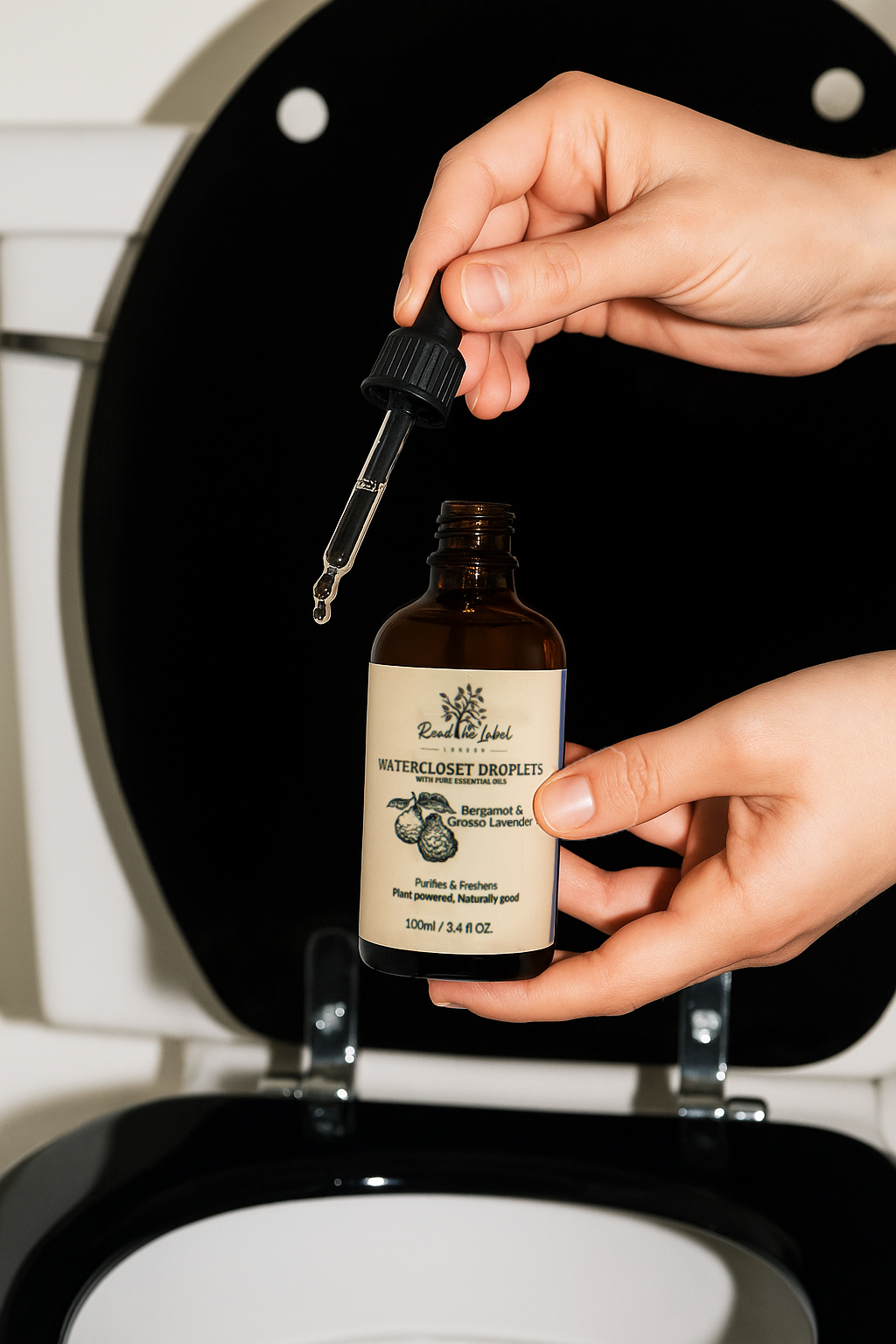
You'll see this transparency in action across our range — our Natural Watercloset Droplets are perhaps the purest expression of it: 100% pure essential oil blends with every ingredient named on the bottle. No propellants, no synthetic Parfum, no umbrella terms.
You'll also find full transparency on the surfactant system (our glucosides come from coconut and sugar), the preservative (Geogard Ultra + Radish Root Ferment — both natural-standard compliant), and the base solvent (purified UK water). No mystery.
How to spot synthetic Parfum on other brands
Now that you know what to look for, here's a quick label-check you can run on any household product:
- Look for "Parfum" or "Fragrance" as a listed ingredient — that's the umbrella term.
- Check whether specific allergens are declared below or in brackets. If yes, that's the regulated minimum — good, but still means the rest is hidden.
- Look for the phrase "contains natural fragrance" or "essential oil blend" — these are usually more transparent, but verify by checking the full ingredient list.
- Cross-reference the brand's website. Genuinely transparent brands publish their full INCI ingredient lists including the fragrance composition. If it's not there, ask them.
Our Multi-Surface Spray range — Bergamot & Grosso Lavender or Eucalyptus & Geranium — is a good starting point if you're switching from a synthetic-fragrance cleaner. Same everyday cleaning power. No Parfum. Full ingredient list. Made in Britain by artisans with 25 years' experience.
Frequently asked questions
Is "Parfum" always synthetic?
Not always — but in a household cleaning context, the vast majority of Parfum blends are synthetic. Natural fragrance blends are typically declared as "essential oil blend" or listed individually because ethical brands want the credit for the transparency.
Are all synthetic fragrances harmful?
No. Some synthetic fragrance molecules are chemically identical to their natural counterparts and pose no known risk. The concern is that under "Parfum", you can't tell which is which. It's the opacity that's the problem, not synthesis in general.
Do essential oils have any risk?
Yes — some essential oils are potent, and citrus oils in particular can cause photosensitivity or contact dermatitis. That's why we declare every allergen and publish full ingredient lists. Informed choice beats hidden formulation every time.
What should I do with cleaning products I already own that contain Parfum?
Use them up rather than binning them if you can (waste isn't the win here). When you replace, choose products that list their fragrance ingredients openly. Look for phrases like "essential oil blend", "scented with organic essential oils", or explicit ingredient breakdowns on the brand's website. Or start with us.
Read every label — especially this one.